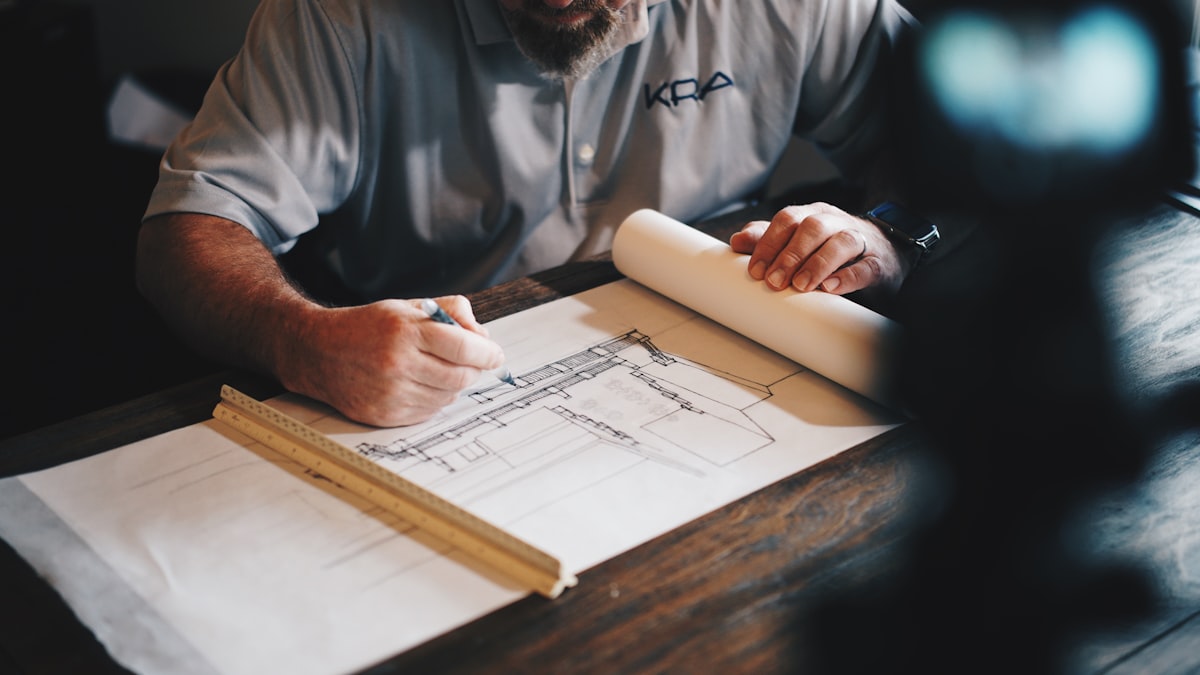
There's a remodeling business in Harrisonburg, Virginia whose website was built five thousand miles away, across an ocean and six time zones, by a team that has never stood in Harrisonburg.
We're that team. This is what the project actually taught us, about craft, about trust, and about the strange fact that distance mattered far less than everyone assumes and listening mattered far more.
Two crafts, one recognition
Here's what struck us early: carpentry and web design are the same job wearing different materials.
A good carpenter doesn't start cutting wood. He measures the space, asks how the family actually uses the kitchen, notices the thing the homeowner didn't think to mention. The craft is mostly understanding; the sawdust comes last.
A good website works identically. The code is the sawdust. The real work was understanding what a homeowner in Virginia needs to feel before letting a contractor into their house, and that had nothing to do with where we were sitting.
When we understood his craft, we understood the assignment: a remodeling website isn't selling carpentry. It's selling the confidence to let a stranger renovate your home. Every design decision flowed downhill from that sentence.
What we had to learn (and how we learned it)
We won't romanticize it: building for a market you don't live in demands homework, and skipping it is how remote projects fail.
We had to learn how American homeowners choose contractors. The reviews-first behavior, the licensing and insurance questions, the way "local" itself is a trust signal. A Virginia homeowner searches "kitchen remodeling Harrisonburg VA" and wants to see their town reflected back, so local SEO wasn't a feature, it was the spine: the town in the titles, the service areas mapped, the business schema tuned for a place we'd never been.
We had to hear the customer's anxiety in a foreign accent. Not language, context. What makes someone in the Shenandoah Valley hesitate before calling a contractor is different in texture from what makes someone in Port Harcourt hesitate. The questions we asked our client about his customers, what do they ask first, what makes them go quiet, what closes them, did the work that living there would have done.
We had to make his realness travel through a screen. His proof was physical: finished kitchens, satisfied families, hands that clearly know wood. Our job was making that tangible to a stranger passing the five-second test, real project photos over stock imagery, the actual towns served, the craftsman himself visible. Trust, translated into pixels without losing anything in transit.
What distance turned out to be
Irrelevant, mostly, with one honest exception and one genuine advantage.
The exception: time zones demand discipline. Overlap hours are precious, so communication gets structured, decisions get documented, and nothing rides on "we'll figure it out at the office." That constraint made us better, the way a carpenter's measured cut beats a hasty one.
The advantage: outsider's eyes. We couldn't lean on assumptions about what "everyone knows" a contractor site looks like, we had to reason from first principles about what one is for. Some of the best decisions in the build came directly from that forced clarity.
The lesson we kept
Craft recognizes craft, and neither carries a passport. The carpenter in Virginia measures twice and cuts once; so do we, in a different material. What clients are actually buying, there, here, anywhere, is someone who takes their livelihood as seriously as they do.
The site is live, it's in our portfolio, and somewhere in Harrisonburg a homeowner is finding a carpenter because a team in Nigeria understood exactly what that homeowner needed to feel. We find that genuinely wonderful, and we suspect the internet was always supposed to work this way.